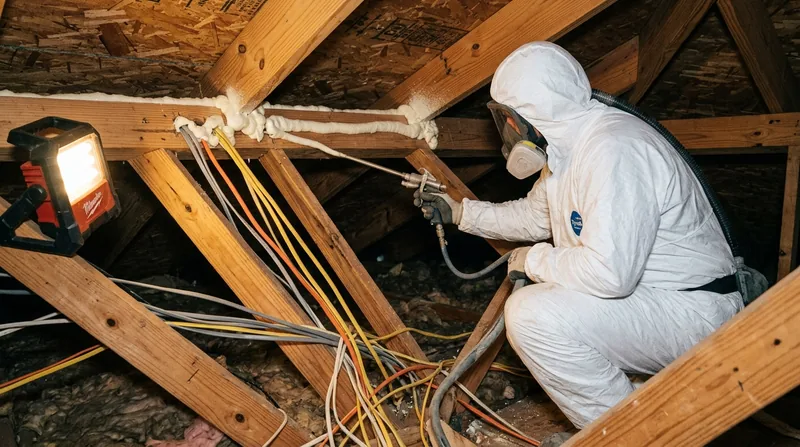




Jacksonville's humid subtropical climate and the age of its housing stock create a perfect storm for air leakage. Riverside bungalows, Arlington mid-century blocks, and newer Mandarin subdivisions all share the same problem: humid air finds its way into attics, crawl spaces, and wall cavities through cracks, gaps, and poorly sealed penetrations. Air sealing in Jacksonville closes those gaps so your cooling system doesn't fight a losing battle against moisture and heat gain all summer long. We seal top plates, rim joists, ductwork penetrations, and electrical chases with spray foam and caulk, creating a continuous air barrier that works with your insulation to hold the envelope tight. This is not decoration. It is the foundation of any insulation job that will actually perform in our climate.
Why Air Sealing Matters in Jacksonville's Hot, Humid Climate
Jacksonville sits in IECC climate zone 2A, where cooling demand runs from May through October and humidity is constant. The stack effect pulls humid outdoor air into attics and crawl spaces through every gap in the thermal envelope. In older homes like those in Riverside and Avondale, the original construction left top plates unsealed, rim joists open to the crawl space, and wall cavities exposed at electrical outlets. In newer subdivisions on the Southside and out toward Orange Park, ductwork runs through vented attics, creating dozens of penetration points where conditioned air leaks out and humid air leaks in. Without air sealing, your insulation is fighting half the battle.
- Humid air infiltration increases your cooling load and makes your AC run longer during Jacksonville's six-month cooling season.
- Moisture in attics and crawl spaces accelerates wood rot, promotes mold growth, and shortens the life of insulation and structural members.
- Air leakage through rim joists and band joists in older homes can account for 20 to 30 percent of total envelope loss.
- Sealing penetrations, electrical chases, and top plates costs far less than replacing rotted framing or dealing with moisture damage down the road.
Proper air sealing is the difference between an insulation job that performs and one that merely looks complete.
Key info: Florida's building code requires air sealing at the thermal boundary in new construction and major renovations. Check with your local building department to understand what applies at your address. Jacksonville, Orange Park, and Atlantic Beach each have their own permitting rules.
For more on how air sealing integrates with attic spray foam insulation, see our full attic service page.
How We Seal Air Leaks in Jacksonville Homes and Buildings
Air sealing starts with a visual inspection of the thermal boundary. In an attic, we look for gaps at the top plate where the wall framing meets the rim, unsealed ductwork penetrations, electrical chases, and gaps around roof trusses. In crawl spaces, we seal the rim joist band, the top of the foundation wall, and any penetrations for plumbing or electrical. In walls, we identify cavities that were never properly sealed during framing and inject foam to close them. Every job is different because every house has a different construction history.
- We inspect the attic, crawl space, or wall cavity to map all gaps, penetrations, and air leakage points.
- We seal top plates and rim joists with closed cell spray foam, which provides both air sealing and structural support.
- We foam around ductwork, electrical penetrations, and plumbing chases to create a continuous air barrier.
- We caulk smaller gaps and joints with polyurethane sealant for a complete, airtight seal.
- We verify the seal visually and document the work with photographs and a written estimate detailing coverage and R-value.
The goal is a tight, continuous thermal boundary that stops humid air from leaking in and conditioned air from leaking out.
Example: A 1960s block home in Arlington with an open crawl space and a vented attic loses cooling through the rim joist band and dozens of penetrations in the attic floor. We seal the rim joist with closed cell foam, then seal the top plates and all ductwork penetrations in the attic. The result is a tight envelope that cuts cooling load and stops moisture from entering the crawl space.
Learn more about rim joist and band joist sealing as a standalone project.
Air Sealing Methods and Approaches
| Approach | Description | Best for |
|---|---|---|
| Closed Cell Spray Foam | Two-part polyurethane foam sprayed at the thermal boundary. Expands to fill cavities and hardens into a rigid, airtight seal. R-value 6.0 per inch. | Rim joists, band joists, top plates, ductwork penetrations, and sealed attics where structural support and moisture resistance are required. |
| Open Cell Spray Foam | Lower-density foam that expands more and cures softer. Fills cavities and seals air leaks. R-value 3.5 per inch. Moisture-permeable. | Interior wall cavities in non-vented assemblies, attic air sealing where vapor permeability is acceptable, and sound dampening. |
| Polyurethane Caulk and Sealant | Applied by gun for smaller gaps, cracks, and joints. Flexible, paintable, and provides both air and moisture sealing. | Gaps smaller than 1 inch, joints between framing members, and finishing touches after foam spray. |
| Injection Foam (Wall Cavities) | Low-pressure foam injected into existing wall cavities through small holes. Expands to fill voids without disrupting drywall or siding. | Retrofit of pre-1980 homes in Riverside, Avondale, and San Marco where walls were built without insulation or with incomplete fills. |
Each method is chosen based on the cavity size, moisture exposure, access, and the thermal boundary classification at your address. We document every approach with R-value and thickness specs so you know what was installed and why.
Air Sealing Cost in Jacksonville: What to Expect
Air sealing costs depend on the square footage of the thermal boundary, the number and size of penetrations, and the access difficulty. A rim joist band in a crawl space under a single-story home might start at $650 and scale up with the perimeter. Sealing an entire attic floor with multiple ductwork penetrations, electrical chases, and soffit vents can run $1,500 to $3,000 or more. Injection foam retrofit of a pre-1980 home with multiple wall cavities is priced per cavity and can range widely depending on the number of walls and the size of the cavities.
The best way to understand the cost for your home is to request a free written estimate. We measure the space, identify all air leakage points, and give you a firm price with R-value and thickness specifications before we start. Most estimates are ready within 24 hours. See our full pricing page for more detail on what drives cost in each scenario.
Call us at (904) 816-3633 to schedule your free estimate. We serve Jacksonville, Orange Park, Atlantic Beach, Fleming Island, Oakleaf Plantation, and all surrounding areas in Duval, St. Johns, and Clay counties.
What to Look for When Hiring an Air Sealing Contractor Near Me in Jacksonville
Not all spray foam contractors are equal. Some are traveling rigs that spray in an afternoon and disappear when the job goes wrong. Others are national franchises that cut corners to hit margin targets. A local contractor with 13 years in Jacksonville knows the climate, the building code, the permitting landscape, and the housing stock. When you call for an estimate, here is what to verify and ask.
- Ask the contractor to provide a written estimate that includes R-value per inch, thickness in inches, and the square footage or linear footage being sealed.
- Request proof of current insurance and ask your local building department whether any permit is required for the work at your address.
- Get at least two estimates so you can compare scope, materials, and price. The lowest bid is often a sign of incomplete work or poor quality.
- Ask about the contractor's experience with your home's era and construction type. A 1920s bungalow in Riverside has different air sealing needs than a 2010 slab home in Mandarin.
- Verify that the contractor has a local address and local plates, not a trailer from out of state, and that they are reachable by phone if a question comes up after the job.
Air sealing is a small project compared to a full attic retrofit, but it is the foundation of any insulation work that will actually perform in Jacksonville's humid climate. Take the time to hire the right contractor the first time.
Ready to get started? Contact us for a free estimate, or call (904) 816-3633 to speak with a technician about your home.
Air Sealing in Jacksonville: Pricing Guide
| Service | Price | Details |
|---|---|---|
| Rim Joist and Band Joist Sealing | Starting at $650 | Closed cell foam seal of the band joist and rim in crawl space, includes inspection and documentation of coverage and R-value |
| Attic Top Plate and Penetration Sealing | Starting at $1,200 | Sealing top plates, ductwork penetrations, electrical chases, and soffit vents in vented attic, scaled by attic square footage and number of penetrations |
| Injection Foam Wall Retrofit (Pre-1980 Homes) | Starting at $400 per cavity | Retrofit of uninsulated or partially filled wall cavities in older homes, priced per cavity based on size and access difficulty |
| Complete Thermal Boundary Sealing | On estimate | Combination of rim joist, attic, wall, and crawl space sealing in a comprehensive retrofit requires on-site inspection to scope and price accurately |
| Travel and Service Area | Included | No separate mileage fee or travel charge within Jacksonville and surrounding areas across Duval, St. Johns, and Clay counties |
| Free Estimate | Free | Written estimate with R-value and thickness specs, response within 24 hours, no obligation to book, call (904) 816-3633 |
Indicative pricing, the exact cost depends on square footage, finish, and site access. Free personalized estimate within 24h at (904) 816-3633.


