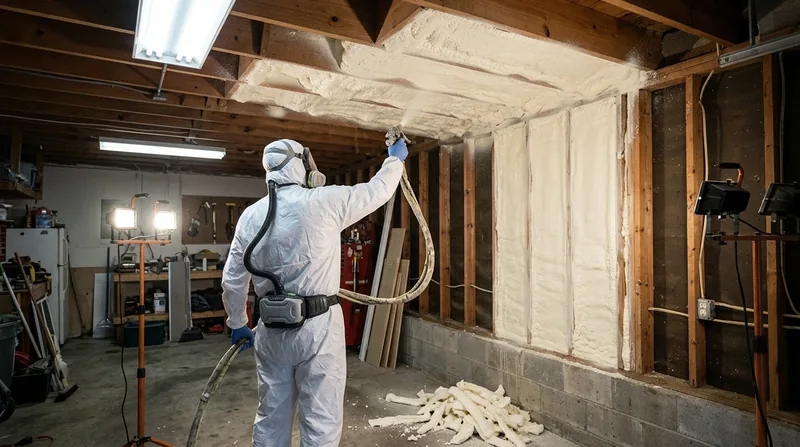




Garages in Jacksonville's Southside and Mandarin neighborhoods often sit directly beneath living spaces, with rooms above and vented attics nearby. When summer heat radiates up through an uninsulated garage ceiling or shared wall, it drives cooling costs higher and makes those rooms uncomfortable. Garage spray foam insulation in Jacksonville seals that thermal leak by applying closed cell or open cell foam to the ceiling and walls that separate your garage from conditioned space above. This is a straightforward, high-impact retrofit that pays for itself quickly in a hot, humid climate where air conditioning runs hard from May through October. We have been installing spray foam insulation across Greater Jacksonville since 2011, and garage jobs are among the most common requests we handle.
Why Garage Spray Foam Insulation Matters in Jacksonville's Newer Subdivisions
Jacksonville's residential stock shifts by era and geography. Mandarin, the Southside, and newer master-planned areas like Oakleaf Plantation and Nocatee carry homes built in the last 20 to 30 years with a common layout: finished rooms over garages, vented attics, and minimal or no insulation on the garage ceiling or the walls between garage and living space. In a climate zone 2A environment where cooling demand dominates and humidity runs year-round, an uninsulated garage ceiling acts as a thermal sieve. Heat soaks into the garage from the roof and radiates straight up into the bedroom or bonus room above, forcing your air conditioning to work harder and longer.
Spray foam addresses this directly:
- It seals air leaks around the perimeter of the garage ceiling and shared walls, stopping convective heat transfer.
- It provides continuous insulation with no gaps or compression, unlike batts or blown-in materials.
- It creates a moisture-resistant barrier that resists the humidity Jacksonville experiences from June through November during hurricane season.
- It reduces noise transmission from the garage into living spaces above, a benefit many homeowners do not anticipate.
Homes in Mandarin and the Southside with rooms over garages see measurable comfort gains and lower summer cooling bills once the garage ceiling and shared walls are properly insulated.
Key info: Jacksonville building code requires that spray foam in garages be covered with a thermal barrier or ignition barrier, depending on the foam type and thickness. We handle this as part of the installation, but the specific requirement is set by your city or county building official. Always verify what applies at your address before you get a bid.
For more information on how spray foam insulation works and what types are available, see our closed cell spray foam insulation page or our open cell spray foam insulation page.
How We Install Garage Spray Foam Insulation in Jacksonville
The process begins with a site visit and a written estimate that specifies the R-value, foam thickness, and coverage area. We assess the garage ceiling height, the condition of the existing structure, any moisture or air leaks, and the best foam type for your situation. Once you approve the estimate, we schedule the work and prepare the space by protecting HVAC ducts, electrical fixtures, and any items you want to keep clean.
Installation follows this sequence:
- We set up mechanical ventilation to manage fumes during the spray and curing process.
- We apply the foam in thin, even passes to the garage ceiling and any shared walls, building to the specified thickness and R-value.
- Once the foam cures, we install the required thermal barrier or ignition barrier as mandated by code.
- We verify the installation meets the estimate specs and clean up the work area.
- We provide you with a re-entry window of 24 to 48 hours before you use the garage normally.
A typical garage ceiling job takes one day, depending on size and access. We work in Jacksonville and surrounding areas, including Orange Park, Atlantic Beach, Jacksonville Beach, and Yulee. See our air sealing page for details on how we seal gaps and penetrations that spray foam alone does not address.
Local example: A Mandarin homeowner with a 400-square-foot garage ceiling and a shared wall to a bonus room above had an uninsulated garage that was driving summer cooling costs up. We sprayed 2.5 inches of closed cell foam on the ceiling and 1.5 inches on the shared wall, achieving an R-value of R-15 on the ceiling and R-9 on the wall. The job took six hours, and the homeowner noticed lower thermostat readings and quieter operation within the first week.
Garage Spray Foam Insulation Methods and Approaches
| Approach | Description | Best for |
|---|---|---|
| Closed Cell Spray Foam | High-density foam that cures to a rigid, moisture-resistant barrier with R-value of 6 to 7 per inch. | Garage ceilings where moisture control and structural strength matter, especially in humid Jacksonville climates. |
| Open Cell Spray Foam | Lower-density foam that cures to a softer, more flexible material with R-value of 3.5 to 4 per inch. Absorbs sound well. | Garage ceilings where cost is a primary concern and noise reduction is a bonus. Requires thicker application to reach target R-value. |
| Foam on Garage Ceiling Only | Insulation applied only to the horizontal ceiling plane, leaving side walls uninsulated. | Budget-conscious retrofit when the primary heat leak is vertical. Works if side walls are already insulated or if living space above is minimal. |
| Foam on Ceiling and Shared Walls | Insulation applied to both the ceiling and the vertical wall that separates garage from conditioned living space. | Rooms directly above the garage or adjacent to it. Stops both vertical and lateral heat transfer and is the most effective approach for occupied spaces. |
| Foam on Existing Insulation (Top-Up) | New foam applied over existing batts or blown-in insulation to increase total R-value. | Garages with partial or aged insulation where removal is not needed and cost is a factor. |
Garage Spray Foam Insulation Cost in Jacksonville: What to Expect
Garage spray foam insulation in Jacksonville typically starts at $1,200 for a small garage ceiling (approximately 200 to 300 square feet) with open cell foam and minimal site preparation. Costs rise based on several real factors: the size of the area being insulated, the foam type chosen (closed cell costs more per board foot than open cell), the required thickness to meet your target R-value, access to the space, and any existing insulation that needs removal or work around.
A 400-square-foot garage ceiling with a shared wall and closed cell foam typically runs between $2,200 and $3,500, depending on foam thickness and local labor rates. If you also insulate side walls or need to remove old insulation first, costs climb. Moisture damage, structural issues, or electrical work that must be completed before foam is applied also adds expense.
The best way to understand your actual cost is to request a free written estimate. We will visit your garage, measure the area, assess the existing condition, discuss your R-value target, and provide a detailed quote that names the foam type, thickness, and coverage. Getting 2 to 3 estimates is smart practice and helps you compare apples to apples. See our full pricing page for additional guidance on what drives cost variation across all our services.
What to Look for When Hiring a Spray Foam Insulation Contractor Near Jacksonville
Jacksonville spans Duval, St. Johns, and Clay counties, and each city or county has its own building code and permitting rules. Before you hire any spray foam contractor, verify that they understand the specific requirements at your address. A reputable contractor will ask about your local building official and will explain what thermal barrier or ignition barrier code requires for your garage. They will also confirm that they are fully insured and will provide proof of insurance upon request.
When you compare contractors, look for these markers of quality and honesty:
- They provide a written estimate with R-value, foam thickness, and coverage area clearly stated, never a vague price per board foot.
- They explain the difference between closed cell and open cell foam and recommend the one that fits your actual use, not just the one that costs more.
- They plan for mechanical ventilation during the spray and cure process and name a re-entry window of 24 to 48 hours, not same-day.
- They verify that permits or code compliance are required at your address and help you understand what applies, never claim to "pull all permits" as a blanket promise.
- They will walk away from a job with moisture, standing water, or a leaking roof until the substrate is dry and the leak is fixed, and they say so plainly.
- They answer questions about their insurance, their process, and their warranty terms directly and without pressure.
Avoid contractors who offer a price far below market with no inspection, who promise same-day re-entry, who make absolute safety claims, or who cannot verify their insurance. These are the hallmarks of rig-and-run operations that leave homeowners with smell complaints, poor coverage, or no recourse when something goes wrong. Contact us to discuss your garage insulation project and to get a free, no-obligation estimate at (904) 816-3633.
Garage Spray Foam Insulation in Jacksonville: Pricing Guide
| Service | Price | Details |
|---|---|---|
| Small garage ceiling (200-300 sq ft) with open cell foam | Starting at $1,200 | Basic coverage to R-10 or R-12, minimal site prep, no removal or structural work required |
| Medium garage ceiling and shared wall (350-450 sq ft) with closed cell foam | Starting at $2,200 | Closed cell provides better moisture control and structural strength in Jacksonville's humid climate |
| Large garage or multi-wall project with removal and thermal barrier | On estimate | Size, existing insulation condition, foam type, and code-required barriers set the price; site visit required |
| Travel and site visit | Included | No mileage fee or travel surcharge within Jacksonville and surrounding areas in Duval, St. Johns, Clay counties |
| Written estimate with R-value and thickness specs | Free | Response within 24 hours at (904) 816-3633, no obligation to book or pay for the estimate |
Indicative pricing, the exact cost depends on square footage, finish, and site access. Free personalized estimate within 24h at (904) 816-3633.


