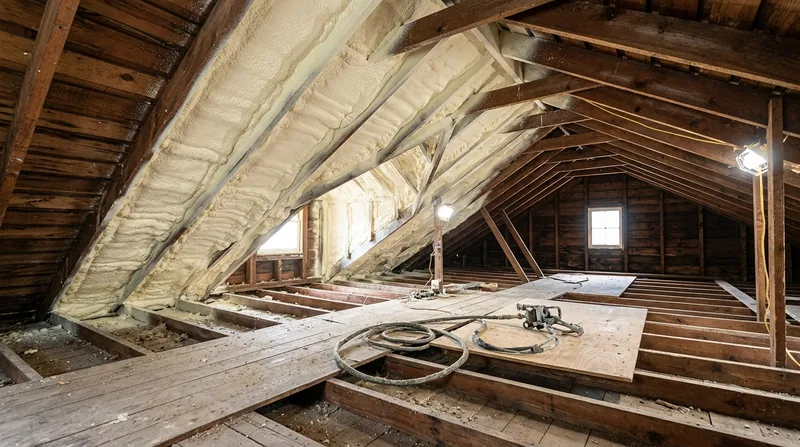




Jacksonville's residential stock spans a century of construction, from Riverside bungalows with crawl spaces to Southside slabs with attics that trap heat all summer. When old insulation fails, settles, or gets contaminated, Insulation Replacement & Re-Insulation in Jacksonville becomes the critical step before you install anything new. The humid climate of IECC zone 2A means vapor drive runs inward for most of the year, so removed insulation must be replaced with materials and installation methods that handle that moisture load. We remove failed fiberglass, cellulose, or spray foam, then install new spray foam or blown-in insulation sized for your home's age, foundation type, and cooling demands. A proper replacement job is not just about R-value on paper; it is about air sealing the rim, the rim joist, the band joist, and the seams that let conditioned air escape into the attic or crawl space.
Why Insulation Replacement Matters in Jacksonville's Hot, Humid Climate
Jacksonville summers run long and wet. Cooling loads dominate the utility bill, and the humidity pulls on your roof, attic, and crawl space all year. Old fiberglass insulation gets wet, compacts, loses R-value, and becomes a breeding ground for mold and mildew. Spray foam installed without proper ventilation during cure can off-gas and smell for months. When you replace insulation, you have a chance to fix the root cause: air leaks that let humid outdoor air into the conditioned space. We start by understanding why the old insulation failed, then remove it completely and replace it with materials and sealing that will hold up in zone 2A.
- We remove all old insulation, debris, and contaminated material from the attic, crawl space, or wall cavity before starting new work.
- We seal air leaks around rim joists, band joists, ductwork, and penetrations that let outside air into the building envelope.
- We install spray foam (closed cell or open cell) or blown-in insulation matched to the space and your budget.
- We verify proper thickness, R-value, and ventilation during cure so the new insulation performs as specified.
Replacing insulation properly is the difference between a cool, dry attic and one that continues to pull moisture and energy into your home every summer.
Key info: A 1950s-era home in Arlington with a vented attic and blown-in fiberglass that has settled to R-10 will run cooling bills 20 to 30 percent higher than the same home with R-38 spray foam and sealed rim joists. Removal and replacement costs more upfront but saves money every month in zone 2A.
For more on how moisture and humidity affect your attic, see our guide to Attic Spray Foam Insulation in Jacksonville.
How We Handle Insulation Removal and Replacement in Jacksonville
Replacement insulation work starts with a detailed assessment of what is already there, why it failed, and what the building code and your home's thermal load demand. We remove old material safely and completely, then seal air leaks before installing new spray foam or blown-in insulation. The process is straightforward but requires attention to detail: improper ventilation during cure, the wrong foam ratio, or skipped air sealing will leave you with the same problems you had before.
- We inspect the existing insulation and identify moisture, settling, contamination, or code violations that drove the need for replacement.
- We remove all old insulation and debris, and we bag and haul it away or recycle it where possible.
- We seal air leaks at rim joists, band joists, ductwork, wiring holes, and other penetrations with spray foam or caulk.
- We install new spray foam (closed cell for maximum R-value and moisture control, or open cell for cost and sound dampening) to the thickness and R-value required by code and your climate.
- We provide a written estimate with R-value, thickness, and coverage area so you know exactly what you are getting.
This step-by-step approach ensures that replacement insulation actually solves the cooling and moisture problems that led to failure in the first place.
Example: A Springfield cottage with a crawl space under the floor had old blown-in fiberglass that had absorbed moisture from the humid soil. We removed all of it, sealed the rim joist and band joist with closed cell foam, and installed new open cell foam in the floor cavity above. The homeowner reported a noticeable drop in floor dampness and cooling bills within the first summer.
For details on the Insulation Removal process, visit our dedicated service page.
| Approach | Description | Best for |
|---|---|---|
| Closed Cell Spray Foam Replacement | High-density foam that blocks moisture and air. Reaches R-6 per inch. Requires mechanical ventilation during cure and a 24 to 48 hour re-entry window. | Crawl spaces, rim joists, attics in humid climates where moisture control is the priority. |
| Open Cell Spray Foam Replacement | Lower-density foam that is vapor-permeable and cost-effective. Reaches R-3.5 per inch. Requires the same ventilation and re-entry protocol as closed cell. | Attics and walls where R-value is the goal and moisture control is secondary to air sealing. |
| Blown-In Insulation Replacement | Cellulose or fiberglass blown into open cavities. Lower cost per board foot. No cure time or off-gassing. Does not block air leaks. | Top-up of a sound attic, or retrofit of existing wall cavities where spray foam access is limited. |
| Spray Foam Plus Air Sealing | Spray foam in key zones (rim joist, band joist, ductwork penetrations) plus blown-in or fiberglass in the rest of the attic or wall. Balances cost and performance. | Large attics or crawl spaces where full foam coverage is not in the budget but air leaks must be sealed. |
Insulation Replacement & Re-Insulation Cost in Jacksonville: What to Expect
Insulation replacement cost depends on the size of the space, the removal labor required, and the material you choose. A typical attic or crawl space replacement in Jacksonville runs from $2,800 for a small space with straightforward removal, up to $8,000 or more for a large, complex job with contaminated material or difficult access. Spray foam costs more per board foot than blown-in insulation, but it seals air leaks and controls moisture in zone 2A's humid climate. Getting two or three written estimates that specify R-value, thickness, and the removal scope will show you the real range and help you avoid low-ball bids that cut corners on ventilation, curing time, or air sealing.
- Attic replacement with removal and open cell spray foam typically starts at $3,500 to $5,000 depending on square footage and access.
- Crawl space replacement with closed cell foam and rim joist sealing usually runs $4,000 to $7,000 for moisture control in Jacksonville's humid climate.
- Wall cavity injection foam retrofit of a pre-1980 home can range from $2,800 to $5,500 depending on the number of bays and the difficulty of drilling access holes.
- Large jobs with extensive removal, multiple zones, or contaminated material require an on-site estimate before a firm price can be quoted.
Visit our full pricing page for more detail on what drives cost in each scenario.
What to Look for When Hiring a Spray Foam Insulation Contractor Near Jacksonville
Hiring the right insulation contractor is about more than price. You need someone who understands Jacksonville's climate, the building code that applies at your address, and the difference between correct spray foam installation and the quick jobs that leave you with smell, moisture, or poor R-value. A qualified contractor will provide a written estimate with R-value and thickness, explain the cure and re-entry window, and be reachable if you have questions after the job. Avoid contractors who promise immediate re-entry, do not mention ventilation during cure, or quote a price without seeing the job in person.
- Verify that the contractor carries full insurance and ask for a certificate of insurance that names your address as an additional insured.
- Request written estimates from at least two contractors that specify R-value, thickness in inches, the material (closed cell or open cell), and the removal scope.
- Ask for references from recent jobs in your neighborhood or a similar home type, and follow up with at least one reference.
- Confirm that the contractor understands the local building code and permitting rules for your city or county in Greater Jacksonville.
- Check that the contractor has a local address, local phone support, and is reachable after the job in case you have questions about cure time or re-entry.
A local, independent contractor who has been in business in Jacksonville for years and can walk you through the why behind the estimate is your best bet against the rig-and-run crews and national franchises that disappear when the smell will not go away.
Call us at (904) 816-3633 for a free, no-obligation estimate, or visit our contact page to request an inspection.
Insulation Replacement & Re-Insulation in Jacksonville: Pricing Guide
| Service | Price | Details |
|---|---|---|
| Small attic replacement | Starting at $2,800 | Removal of old insulation plus open cell foam in attics under 800 square feet with straightforward access and no contamination |
| Crawl space replacement with moisture control | Starting at $4,200 | Removal, rim joist and band joist sealing with closed cell foam, plus crawl space floor insulation for humidity management |
| Wall cavity injection foam retrofit | Starting at $3,100 | Drilling access holes and injecting foam into closed wall cavities of pre-1980 homes without interior demolition or drywall removal |
| Large or complex replacement job | On estimate | Extensive removal, contaminated material, difficult access, or multiple zones require on-site assessment before pricing |
| Travel | Included | No mileage charge or travel fee within Jacksonville and surrounding Clay, St. Johns, and Duval county service areas |
| Free estimate | No obligation | Written quote with R-value, thickness, and removal scope provided within 24 hours by calling (904) 816-3633 |
Indicative pricing, the exact cost depends on square footage, finish, and site access. Free personalized estimate within 24h at (904) 816-3633.


