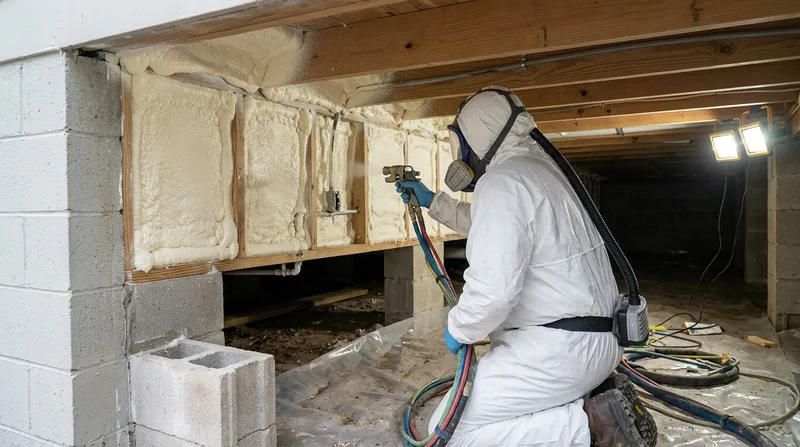




Closed cell spray foam insulation in Jacksonville is the high-performance answer to the moisture and heat that dominate this region year-round. Jacksonville's climate sits in IECC zone 2A, hot and humid, with vapor drive pushing into walls and crawl spaces from outside for most of the year. Whether you own a century-old bungalow in Riverside with a damp crawl space, a mid-century concrete block home in Arlington with an attic that traps summer heat, or a newer Mandarin subdivision with rim joists facing salt-humid air near the St. Johns River, closed cell foam forms a continuous air and moisture barrier that open cell foam and blown-in fiberglass cannot match. It resists the long cooling season, holds strong through hurricane season storms, and stops the humidity that degrades other insulation types. This is the technical foundation that justifies the investment, and it is measured in R-value and thickness on site, not in promises.
Why Closed Cell Spray Foam Matters in Jacksonville's Humid Climate
Jacksonville's residential fabric is split across eras and terrain. Riverside, Avondale, San Marco, and Springfield hold early-1900s bungalows with crawl spaces under the floor and original wall cavities never designed for today's moisture loads. Arlington carries mid-century concrete block homes where attics trap heat all summer. Mandarin and the Southside run newer slab-on-grade subdivisions with rooms over garages and ductwork run through vented attics. Out toward Orange Park and across into Clay County, homes sit on slabs with attics as the main thermal boundary. The constant here is humidity and vapor drive from the St. Johns River corridor and the Atlantic, plus hurricane season moisture stress from June through November. Closed cell foam resists this environment in ways that fiberglass, open cell foam, and blown-in cellulose do not.
- Closed cell foam carries an R-value of 6.0 to 7.0 per inch, giving you meaningful thermal resistance in tight spaces like rim joists and band joists where thick batts do not fit.
- It forms a continuous air barrier that stops convection losses through rim joists and band joists, the thermal weak points in most Jacksonville homes.
- The closed cell structure resists moisture absorption, critical in crawl spaces and attics where humidity and seasonal condensation are constant threats.
- It adheres to concrete, wood, and masonry, holding its seal through the temperature swings and humidity cycles of a Jacksonville summer and the salt air near coastal neighborhoods.
- It performs under the pressure of hurricane-season wind and moisture without degrading or allowing air leakage that would compromise your thermal envelope.
When humidity is the dominant failure mode, closed cell spray foam is the material that addresses it directly.
Key info: A crawl space under a 1920s Riverside bungalow pulls in damp air year-round, degrading fiberglass batts and blown-in insulation. Closed cell foam, sprayed on the rim band and the underside of the rim joist, creates a vapor-resistant seal that stops moisture at the source. This is the highest-value application for closed cell in Jacksonville, and it is why crawl space insulation carries the premium price it does.
For guidance on permitting and code compliance in your neighborhood, check with the City of Jacksonville building department or your local city or county authority. Thermal barriers, ignition barriers, and attic ventilation rules vary by address and are set by the building official at your location, not by us. Always verify what applies before work begins.
How We Install Closed Cell Spray Foam Insulation in Jacksonville
Closed cell foam is applied in a multi-pass process, with each pass carefully controlled for thickness, equipment temperature, and material ratio. The work itself is fast, but the preparation and post-cure timeline are what separate a professional installation from a rig-and-run job. We start with a site assessment to measure the area, identify moisture sources, and confirm the substrate is dry and sound. If we find a wet crawl space, a leaking roof, or any moisture issue, we stop and walk away. The foam does not fix water; it seals air, and sealing water in is a path to mold and structural failure.
- We measure the substrate and plan the spray pattern to hit the target R-value and thickness specified in your estimate, documented in writing before the work begins.
- We set up mechanical ventilation during the spray and cure process to control off-gassing and ensure the space is safe for re-entry.
- We apply closed cell foam in controlled passes, allowing each layer to cure before the next, so the final thickness and density are uniform and meet code.
- We trim the cured foam flush to the framing, leaving a clean, finished surface that meets fire code and is ready for any finishing work your project requires.
- We provide a written record of the R-value, thickness, and location of the work, so you and the building inspector can verify the installation meets code.
A typical attic or crawl space job in Jacksonville takes one to two days on site, with a re-entry window of 24 to 48 hours before normal occupancy. The smell diminishes rapidly once ventilation is running, and it is gone within a week in most cases.
Example: A 1950s Arlington home with a concrete block wall and an uninsulated attic over a vented soffit. We spray 5.5 inches of closed cell foam on the underside of the roof deck, creating an unvented attic that stops the summer heat load and eliminates the humidity pull of the vented soffit. The homeowner gets a 48-hour re-entry window, and the attic becomes a sealed, conditioned space. Cost and payback depend on the square footage, but this is the signature closed cell job in Jacksonville.
For more on how closed cell compares to open cell and blown-in insulation, see our open cell spray foam page for a detailed comparison.
Closed Cell Spray Foam Insulation Methods and Applications
| Approach | Description | Best For |
|---|---|---|
| Sealed Roof Deck | Closed cell foam sprayed on the underside of the roof sheathing, creating an unvented attic that becomes part of the thermal envelope. | Mid-century and newer homes in Arlington, Mandarin, and Southside subdivisions where attic heat is the dominant cooling load. |
| Rim and Band Joist Sealing | Closed cell foam sprayed directly into the rim joist cavity and around the band board, sealing air leakage and resisting moisture. | Early-1900s Riverside and Avondale bungalows with crawl spaces and older wood-frame construction where air leakage and moisture are the primary losses. |
| Crawl Space Encapsulation Support | Closed cell foam sprayed on the underside of the rim board and upper rim joist to seal the thermal boundary above the crawl space. | Damp crawl spaces in pre-1980 homes where vapor drive is constant and fiberglass batts have failed or are absent. |
| Wall Cavity Injection | Closed cell foam injected into existing wall cavities from the exterior or interior, filling voids without demolition. | Retrofit work in San Marco, Springfield, and other older neighborhoods where original walls have no insulation or failed batts. |
| Metal Building and Garage Walls | Closed cell foam sprayed on the interior of metal panels or garage framing, controlling condensation and providing thermal resistance. | Barndominiums, metal outbuildings, and garage conversions in Clay County and rural Jacksonville where condensation on steel is the primary concern. |
Closed Cell Spray Foam Insulation Cost in Jacksonville: What to Expect
Closed cell spray foam in Jacksonville starts at approximately $1.20 per board foot, with most residential jobs in the range of $1.20 to $2.00 per board foot depending on access, substrate condition, and the complexity of the spray pattern. A board foot is the unit of measurement on site: one foot by one foot by one inch thick. A 1,000-square-foot attic sprayed to 5.5 inches of closed cell foam is roughly 4,583 board feet, which puts the material cost in the $5,500 to $9,000 range before labor, equipment, and permitting. The final price depends on several concrete factors.
- Substrate condition matters: a clean, dry crawl space or attic is faster to spray than one with old insulation, debris, or moisture that must be addressed first.
- Access and layout affect spray time: a simple attic with clear framing is cheaper per board foot than a cramped crawl space with low headroom and narrow rim joists.
- Thickness and R-value determine board feet: 3.5 inches of closed cell is cheaper in total dollars than 5.5 inches, but both are priced per board foot, so you get what you specify.
- Permitting and inspection fees are set by your city or county and vary by address; these are separate from the spray foam cost and are your responsibility to budget.
- Travel is included in Jacksonville and surrounding areas; we do not charge a separate mileage fee or call-out charge for estimates or work.
The best way to know your cost is to get a written estimate that includes the R-value, thickness in inches, the total board feet, and the price per board foot. We provide this in writing before any work begins. See our pricing page for more detail on how we structure estimates and what factors move the per-board-foot rate.
Real example: A 2,000-square-foot attic in Jacksonville Beach with moderate access and a clean substrate, sprayed to 5.5 inches of closed cell foam for an R-value of 38 to 40, runs approximately 9,167 board feet. At $1.40 per board foot, that is roughly $12,800 in material and labor, plus any permit fee your city requires. If you are topping up an existing attic with partial insulation instead of starting from zero, the cost drops because you are filling gaps, not covering the whole floor.
What to Look for When Hiring a Closed Cell Spray Foam Contractor Near Me in Jacksonville
Jacksonville has both local independent spray foam shops and national franchises, and the difference in accountability and quality is real. A rig-and-run crew shows up in an out-of-state trailer, sprays the job in an afternoon with no ventilation running, promises immediate re-entry, quotes a price far below market with no written specs, and is unreachable when the smell will not go away or the foam is too thin. A professional local shop gives you a written estimate with R-value and thickness, runs mechanical ventilation during cure, specifies a 24- to 48-hour re-entry window, and is reachable by phone and email when you have questions after the work is done. Here is what to verify before you hire any contractor, including us.
- Ask for a written estimate that includes the R-value per inch, the target thickness in inches, the total board feet to be sprayed, and the price per board foot or total price.
- Confirm the contractor carries full insurance coverage and ask for a certificate of insurance that names you as an additional insured for the duration of the work.
- Check references from at least two recent jobs in Jacksonville, Orange Park, or Atlantic Beach, and ask about the smell timeline and the contractor's responsiveness after the job.
- Verify that the contractor understands your local building code and permitting requirements by asking what thermal barrier or ignition barrier applies at your address.
- Ask whether the contractor will obtain the permit or help you navigate what your city or county requires; permitting rules vary by address and there is no statewide reciprocity.
- Confirm the re-entry window in writing, typically 24 to 48 hours, and understand that mechanical ventilation during cure is non-negotiable for safety.
Call us at (904) 816-3633 for a free, no-obligation estimate. We respond within 24 hours, provide written specifications, and are fully insured. You can also request an estimate online and we will confirm a time that works for you.
Closed Cell Spray Foam Insulation in Jacksonville: Pricing Guide
| Service | Price | Details |
|---|---|---|
| Rim and Band Joist Sealing | Starting at $1.20/board ft | Closed cell foam in rim joists and band boards, the highest-value application; access and linear footage are the main cost drivers |
| Sealed Attic (Roof Deck) | Starting at $1.20/board ft | Closed cell foam on underside of roof sheathing; cost scales with square footage and thickness in inches, typically 3.5 to 5.5 inches |
| Wall Cavity Injection | Starting at $1.40/board ft | Closed cell foam injected into existing wall cavities; complexity of access and substrate condition move the price up within the range |
| Crawl Space Rim Board and Ceiling | Starting at $1.20/board ft | Foam applied to rim board and underside of band joist; damp conditions and moisture remediation required before spray may increase total cost |
| Estimate and Site Inspection | Free | Response within 24 hours at (904) 816-3633; written estimate includes R-value, thickness, board feet, and price before work begins |
Indicative pricing, the exact cost depends on square footage, finish, and site access. Free personalized estimate within 24h at (904) 816-3633.


