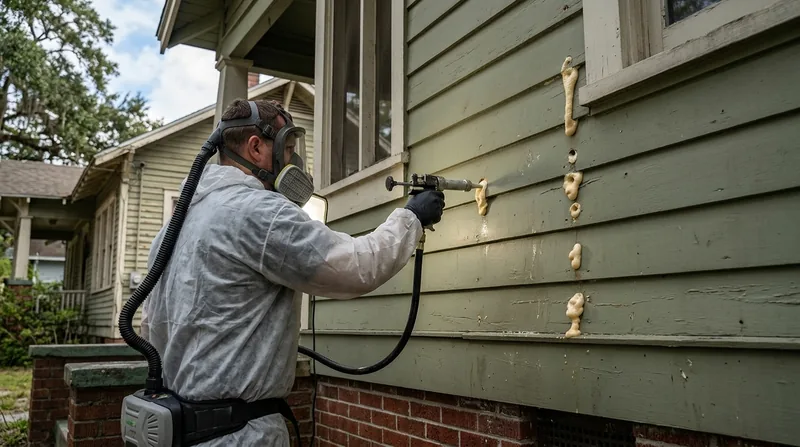




Jacksonville's historic neighborhoods like Riverside, Avondale, and San Marco hold some of the oldest residential stock in Florida, with early-1900s bungalows and cottages built with wall cavities never designed for today's cooling loads and humidity. These original plaster walls trap heat all summer, and tearing them open for insulation means weeks of restoration work. Wall and injection foam insulation solves this without demolition, injecting foam directly into existing cavities from outside or inside, sealing air leaks and adding R-value where it matters most. Since 2011, we have helped Jacksonville homeowners retrofit these vintage homes and mid-century concrete block properties across Duval, St. Johns, and Clay counties, keeping cooling bills manageable without gutting walls. Call us at (904) 816-3633 for a free estimate, or read on to understand how injection foam works in Jacksonville's climate and what to expect.
Why Wall and Injection Foam Insulation Matters in Jacksonville's Older Homes
Jacksonville's residential neighborhoods split by era and construction method. Riverside and Avondale bungalows from the 1920s and 1930s have plaster walls and crawl spaces, while Arlington's mid-century concrete block homes sit under unvented attics that pull in humid air all summer. The St. Johns River corridor and slab-on-grade subdivisions toward Mandarin and the Southside rely on attics as the primary thermal boundary, but older wall cavities in every zone leak air and admit moisture. This is IECC climate zone 2A, hot and humid year-round, with vapor drive running from outside in for most of the year. A leaky wall cavity in a 1940s home in San Marco or a 1960s concrete block house in Arlington can cost hundreds of dollars in extra cooling per summer, and the humid air that leaks in encourages mold growth inside the wall itself.
- Injection foam seals air leaks in existing walls without removing plaster, drywall, or siding.
- The foam expands to fill cavities completely, blocking humid air and reducing cooling load in summer.
- Jacksonville's humidity and long cooling season make airtight walls a bigger payoff than in drier climates.
- Older homes with settled or missing original insulation see the fastest return on injection foam work.
These improvements add up fast in a climate where cooling runs nine months a year and humidity is the hidden cost.
Key info: A 1940s plaster-wall home in Riverside with no cavity insulation and air leaks at every outlet and window frame can lose 30 to 40 percent of conditioned air before it reaches the room. Injection foam tightens that envelope without a single wall opened.
For more on how spray foam handles Florida's humidity, see our page on closed cell spray foam insulation, which is the standard for wall cavities in Jacksonville's climate.
How We Inject Foam Into Your Walls: The Jacksonville Process
Injection foam insulation starts with a site visit to map the wall cavity layout, check for any existing insulation, moisture, or obstructions, and plan the injection points. We drill small holes (typically 1 to 1.5 inches) into the wall cavity from outside or inside, depending on access and your preference. The foam is mixed at the correct ratio and temperature, then injected under controlled pressure to fill the cavity completely without over-pressurizing the wall. Once cured (24 to 48 hours), the holes are patched and finished to match your wall. The whole process is quieter and faster than blown-in fiberglass and leaves no mess inside your home.
- We assess wall cavity depth, width, and existing condition before any drilling or foam application.
- Holes are drilled at intervals to ensure complete fill without gaps or voids.
- Foam is injected at manufacturer-specified pressure and temperature for proper expansion and adhesion.
- Mechanical ventilation runs during cure to manage any off-gassing and ensure safe re-entry.
- Patches are applied and finished to blend with your wall exterior or interior.
This method works on plaster, drywall, vinyl, and brick veneer, making it ideal for Jacksonville's mixed housing stock.
Example: A San Marco cottage with 2x4 plaster walls and no cavity insulation receives injection foam at eight points across the front wall. Holes are drilled from outside, foam fills the cavity, and patches are painted to match the plaster. The job takes one day, and the homeowner can re-enter after 36 hours. Summer cooling bills drop 12 to 18 percent on that wall alone.
To understand the difference between injection foam and other retrofit methods, visit our air sealing page to see how foam fits into a complete envelope strategy.
Wall and Injection Foam Insulation Methods: Choosing the Right Approach
| Approach | Description | Best for |
|---|---|---|
| Closed Cell Injection | High-density foam (1.5 to 2 lb/cu ft) injected into cavities. Expands to fill completely and cures rigid. R-value 6.0 to 7.0 per inch. | Walls in humid climates, cavities with moisture risk, or where vapor barrier is needed. Jacksonville standard for existing walls. |
| Open Cell Injection | Lower-density foam (0.5 to 0.7 lb/cu ft) injected into cavities. Softer, more flexible, R-value 3.5 to 3.8 per inch. Requires interior vapor barrier. | Retrofit walls where cost is primary concern and interior drywall is present for vapor control. Less common in Jacksonville due to humidity. |
| Exterior Access Injection | Holes drilled from outside (foundation, brick, vinyl siding). Foam injected from exterior. Patches match exterior finish. | Homes where interior walls are occupied or difficult to access. Common in Riverside and Avondale cottages with brick or plaster exteriors. |
| Interior Access Injection | Holes drilled from inside (drywall, plaster). Foam injected from interior. Patches done on interior wall face. | Basements, garages, unfinished spaces, or where exterior access is blocked. Allows inspection of cavity before filling. |
Closed cell is the Jacksonville standard because it handles moisture and provides the highest R-value in tight cavities. Exterior access is preferred when the interior is finished, interior access when the wall is unfinished or the exterior is difficult to work on.
Wall and Injection Foam Insulation Cost in Jacksonville: What to Expect
Injection foam insulation in Jacksonville typically starts at $2 to $4 per square foot of wall cavity, depending on cavity depth, existing insulation, access difficulty, and whether the work is from exterior or interior. A 500-square-foot wall (a typical side of a 1,200-sq-ft cottage) runs $1,000 to $2,000 before patches and finishing. Larger projects or complex access (brick veneer, multiple stories, or interior obstructions) move toward the higher end. The cost of an on-site estimate is zero, and we respond within 24 hours.
Several factors move the price:
- Cavity depth and width determine how much foam is needed and how many injection points are required.
- Existing insulation or debris inside the cavity may need removal before foam is applied, adding labor.
- Exterior access (brick, stucco, vinyl) costs more than interior access (drywall) because patches must match the exterior finish.
- Multiple stories or complex framing (like around windows or doors) increases drilling and injection time.
- Patching and finishing (paint, caulk, or mortar) are included but vary by material and surface.
Getting two or three estimates from local contractors is smart. Compare the R-value specified, the injection method (exterior vs. interior), the warranty on workmanship, and whether the estimate includes patching and finishing. A low bid with no R-value spec and no mention of curing time or ventilation is a red flag. Call us at (904) 816-3633 for a free estimate and see our full pricing page for more detail on how we structure costs.
What to Look for When Hiring a Spray Foam Contractor Near Me in Jacksonville
Jacksonville's spray foam market includes local independent shops, national franchises, and out-of-state crews that spray a job in an afternoon and disappear. The difference between a good installation and a failed one comes down to technique, ventilation during cure, and accountability after the work is done. Before you hire, verify a few key things. First, confirm that the contractor is fully insured and can provide a certificate of insurance. Second, ask for written estimates that specify the R-value per inch, the foam thickness in each cavity, the access method, and the curing time before re-entry. Third, check references from recent jobs in Jacksonville, not generic company testimonials. Fourth, understand your city's permit requirements by calling your local building department (Jacksonville, Orange Park, Atlantic Beach, and other cities have different rules), and confirm the contractor will help you navigate what applies at your address.
- Fully insured status and a current certificate of insurance are non-negotiable; ask to see both.
- Written estimates must include R-value, thickness, injection points, access method, and re-entry window.
- References from recent Jacksonville jobs (not franchise templates) show the contractor's local track record.
- Check your city's building department website or call to confirm whether permits are required for wall insulation work at your address.
- Avoid contractors who promise immediate re-entry, offer prices far below market, or cannot explain their foam ratio and curing process.
- Ask about workmanship warranty (typically one to three years) and what it covers.
The strongest signal of a professional is honesty about what injection foam can and cannot do. It seals air leaks and adds insulation. It does not fix a roof leak, cure a moisture problem in the wall, or replace a failed HVAC system. If a contractor promises to spray over a wet substrate or claims to fix mold, walk away. Ready to get started? Contact us for a free estimate or call (904) 816-3633.
Wall & Injection Foam Insulation in Jacksonville: Pricing Guide
| Service | Price | Details |
|---|---|---|
| Injection Foam (Closed Cell) | Starting at $2/sq ft | Cavity depth, width, and existing insulation condition determine final price per square foot of wall area |
| Exterior Access (Brick, Stucco, Vinyl) | Starting at $3/sq ft | Exterior drilling and patching to match finish cost more than interior access; larger projects see better per-sq-ft rates |
| Interior Access (Drywall, Unfinished) | Starting at $2/sq ft | Interior holes and patches cost less to execute; best for basements, garages, or unfinished spaces |
| Complex or Large-Scale Job | On estimate | Multi-story homes, tight access, or cavities with obstructions need site assessment before pricing is final |
| Travel | Included | No mileage fee or travel charge within Jacksonville and surrounding service areas across Duval, St. Johns, and Clay counties |
| Free Estimate | No obligation | Written estimate with R-value and thickness specs, response within 24 hours at (904) 816-3633 |
Indicative pricing, the exact cost depends on square footage, finish, and site access. Free personalized estimate within 24h at (904) 816-3633.


