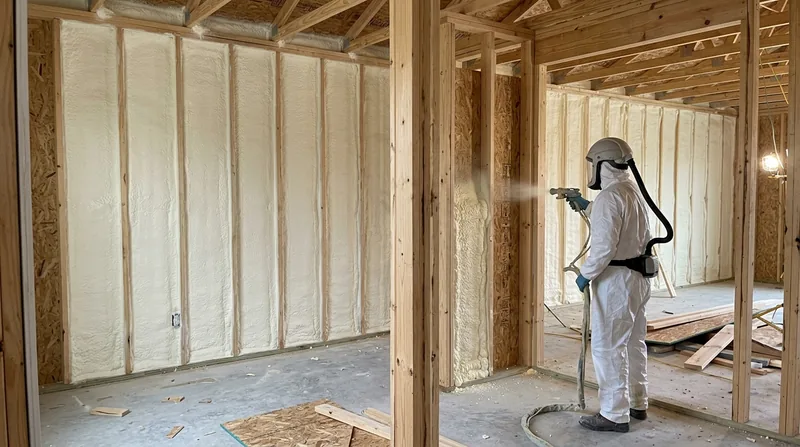




New construction and commercial buildings across Jacksonville, Orange Park, and St. Johns County offer a rare advantage: you can plan commercial and new construction spray foam insulation into the project from the start. Unlike retrofit work, where we're fitting insulation into existing walls and attics, new builds let us integrate air sealing and foam application before drywall closes in, meeting the energy code that applies at your address and avoiding costly rework later. Jacksonville's hot, humid climate and long cooling season mean that thermal efficiency and moisture control are not luxuries on a new commercial shell or a builder's residential project. We work with general contractors, developers, and property managers across Duval and Clay counties to seal walls, attics, and mechanical cavities before they're locked away, saving time and ensuring the building performs from day one.
Why Planning Spray Foam into New Construction Matters in Jacksonville
Jacksonville's residential and commercial building stock spreads across slab-on-grade subdivisions, mid-century concrete block structures, and newer developments where attics and wall cavities are the primary thermal boundaries. The climate is IECC zone 2A: hot, humid, and driven by cooling load rather than heating. Vapor drive runs from outside in for most of the year, and humidity load on ductwork, rim joists, and wall cavities becomes a performance issue fast. When spray foam insulation and air sealing are specified in the design phase, builders avoid the cost of retrofitting after drywall, reduce punch-list callbacks, and deliver a building that meets code on the first inspection.
- Plan air sealing into walls, attics, and mechanical chases before drywall closes in, eliminating costly rework and re-inspection delays.
- Meet IECC and Florida energy code requirements with a single, verifiable air barrier and R-value documented in the estimate and inspection record.
- Control vapor drive and humidity in rim joists, band joists, and crawl spaces under slabs before moisture becomes a complaint or a warranty claim.
- Integrate closed cell spray foam into metal roof decks and steel framing to prevent condensation and thermal bridging in commercial shells and agricultural buildings.
Planning spray foam into the specification phase is the difference between a building that performs and one that underperforms from move-in day.
Key info: Florida's energy code is enforced by the local building department at your address. Duval County, St. Johns County, and Clay County each have their own permitting and code enforcement staff. We help you understand what applies to your project and work with your builder's general contractor to coordinate inspections and timing. Always verify code requirements with your local building official before finalizing specifications.
For more detail on how we handle air sealing across all applications, see our air sealing service page.
How We Work with Builders and General Contractors in Jacksonville
Our approach to new construction is built on coordination and documentation. We review the plans, confirm the energy code and R-value requirements at your address, provide a written estimate that specifies thickness and board-foot volume, and schedule the work to fit the construction sequence. Once the building shell is framed and windows are in place but before drywall or roof decking closes in, we apply the foam, verify coverage and thickness, and document the work with photos and a completion report that the builder can submit to the building official.
- Review the plans and confirm the energy code, R-value, and air sealing scope that applies at your address.
- Provide a written estimate with R-value, thickness per pass, total board feet, and labor schedule so the builder can sequence the work correctly.
- Coordinate timing: spray foam is applied after framing and windows are installed but before drywall or roof decking closes in.
- Apply the foam to walls, attics, rim joists, and mechanical cavities, controlling thickness and ratio to meet the specification and the manufacturer's requirements.
- Document the work with photos, thickness readings, and a completion report that the builder submits to the building official.
This sequence keeps the project on schedule and ensures the building passes inspection on the first attempt.
Example: A new 12-unit townhome development in Jacksonville Beach specifies closed cell spray foam in the rim joists and open cell in the attic to control humidity and meet the energy code. We provide an estimate broken down by unit, the builder sequences the work after framing, and we complete the spray before drywall is hung. The building official inspects the foam coverage, approves the thickness, and the project moves to the next phase on time.
For detail on the specific foam types and their applications, see closed cell spray foam and open cell spray foam pages.
Spray Foam Methods and Applications for New Construction
| Application | Foam Type | Best for |
|---|---|---|
| Sealed attic decks and roof assemblies | Closed cell or open cell | New construction where the attic is sealed and conditioned; closed cell for metal roof decks to prevent condensation. |
| Rim joists and band joists | Closed cell | Thermal bridging and moisture control at the foundation edge; closed cell provides the vapor barrier and insulation in one application. |
| Wall cavities (open stud bays) | Open cell or closed cell | Exterior and interior walls; open cell for cost-effective attic and wall spray; closed cell where vapor control is required. |
| Metal building and pole barn shells | Closed cell | Condensation control on steel framing; closed cell adheres to metal and provides a continuous air and vapor seal. |
| Mechanical chases and ductwork cavities | Closed cell | Air sealing and thermal protection of HVAC runs; closed cell stops air leakage and prevents condensation on cold ductwork. |
Commercial and New Construction Spray Foam Cost in Jacksonville: What to Expect
The cost of spray foam insulation in new construction depends on the scope, the foam type, the building size, and the complexity of the application. A new residential project with spray foam in the attic and rim joists will cost less per square foot than a commercial metal building where closed cell foam is applied to the entire roof deck and walls. We provide a free commercial estimate that breaks down the cost by zone, foam type, R-value, and labor. The estimate includes the board-foot volume, thickness per pass, and the labor schedule so you know exactly what you're paying for and when the work will be done.
Factors that affect the cost include the total square footage to be sprayed, the foam type (open cell is less expensive than closed cell), the R-value target, access and staging, and whether the substrate requires preparation or repair before foam is applied. A simple attic spray on a new single-family home costs less than a complex commercial build with multiple foam types, sealed decks, and metal framing. We recommend getting 2 to 3 estimates from local contractors so you can compare scope, thickness, and price. Always ask for a written estimate that specifies R-value and thickness, not just a per-board-foot price.
For detailed pricing and to schedule your free estimate, call us at (904) 816-3633 or visit our pricing page. We respond within 24 hours and provide a no-obligation quote.
What to Look for When Hiring a Spray Foam Contractor Near Jacksonville
Choosing the right spray foam contractor is critical to the success of your new construction project. A good contractor will provide a written estimate that specifies R-value, thickness, and board-foot volume, not just a flat price. They will explain the energy code requirements at your address and how the foam meets them. They will document the work with photos and a completion report that the builder can submit to the building official. They will be fully insured and available to answer questions during and after the installation.
Here's what to verify when comparing contractors near Jacksonville:
- Ask for a written estimate that specifies R-value, thickness per pass, and total board feet, not a vague per-square-foot price.
- Verify the contractor's insurance coverage and ask for a certificate of insurance naming your builder or project as an additional insured.
- Check references from recent new construction or commercial projects in Jacksonville, Orange Park, or nearby areas.
- Confirm that the contractor understands the local building code and will coordinate with the building official for inspections.
- Ask how the contractor handles substrate preparation, ventilation during cure, and the re-entry window before the space can be occupied or drywall installed.
- Verify that the contractor is reachable during and after the job and has a clear process for addressing questions or concerns.
A local, independent contractor with a track record in Jacksonville's new construction market is often more responsive and accountable than a national franchise or a crew that travels from out of state and disappears after the spray is done.
Ready to get started? Contact us for a free estimate or call (904) 816-3633. We work with builders and general contractors across Jacksonville and surrounding counties.
Commercial & New Construction Spray Foam in Jacksonville: Pricing Guide
| Service | Price | Details |
|---|---|---|
| Free commercial estimate | No charge | Written estimate with R-value, thickness, board feet, and labor schedule for your project scope |
| Residential new construction (attic and rim joists) | Starting at $1,200 | Depends on square footage, foam type, R-value target, and substrate access and condition |
| Commercial metal building or sealed deck | Starting at $2,500 | Closed cell spray foam on steel framing and roof decks; price scales with building size and condensation control requirements |
| Multi-unit or large commercial project | On estimate | Requires on-site evaluation of square footage, building geometry, foam type, and sequencing with construction schedule |
| Travel and mobilization | Included | No separate mileage or call-out fee in Jacksonville and surrounding areas within service territory |
| Estimate response time | Free | Response within 24 hours of request; no obligation to book after estimate is provided |
Indicative pricing, the exact cost depends on square footage, finish, and site access. Free personalized estimate within 24h at (904) 816-3633.


