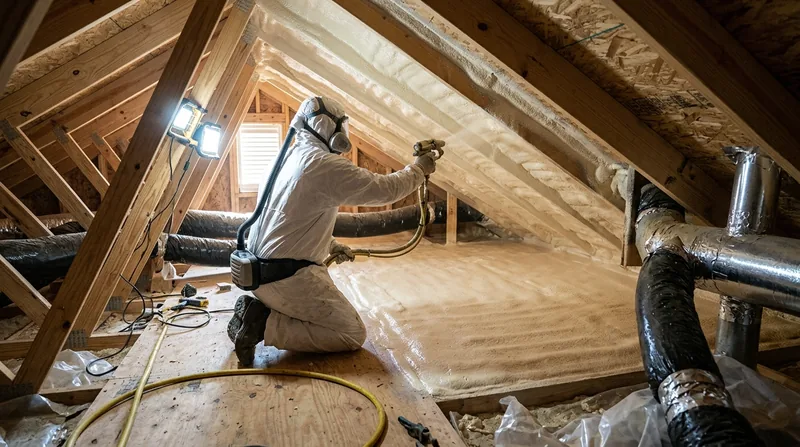




Jacksonville attics face a relentless heat load from June through November, and the cooling season stretches nine months long across Arlington's mid-century concrete block homes and the newer Southside subdivisions where rooms sit over garages and ductwork runs through vented attics. When outdoor air pushes into a vented attic, return ducts leak conditioned air into the heat, and your cooling system works against the building envelope instead of with it. Attic spray foam insulation on the roof deck transforms that thermal boundary into an unvented assembly, keeping ductwork and mechanical equipment out of the heat load and cutting the energy penalty that kills summer bills in this climate. We spray closed cell or open cell foam directly onto the underside of the roof deck, seal every penetration and rim, and create a conditioned space that stays with your home, not against it. This is the signature retrofit for Jacksonville's housing stock, and it works.
Why Attic Spray Foam Insulation Matters in Jacksonville's Heat and Humidity
Jacksonville sits in IECC climate zone 2A, hot and humid, which means vapor drive runs from outside in for most of the year. Your attic is not a sealed box; it is an air plenum connected to your return ducts, and every degree of temperature difference between inside and outside pulls air into the space. Vented attics in Arlington, Mandarin, and across the Southside absorb 140-degree roof surface heat in July, and that heat radiates down onto ductwork and wiring. Unvented attics created with spray foam on the roof deck stay 15 to 25 degrees cooler because they are part of the conditioned space, not a separate thermal zone fighting against it. The long cooling season and the humidity load here make this the highest-return insulation upgrade a homeowner can make.
- Keeps ductwork and HVAC equipment out of the 140-degree attic heat, reducing compressor strain and cycle time.
- Seals air leaks at the roof deck, soffit, and rim board where vented attics pull in unconditioned air year-round.
- Eliminates moisture stratification in the attic, which is the driver of mold and wood rot in Jacksonville's humid climate.
- Allows you to run return ducts and equipment in a conditioned space without penalty, simplifying ductwork layout and reducing leakage.
- Qualifies for the federal energy efficiency tax credit when the R-value and installation meet code standards.
These benefits compound over a nine-month cooling season, and the payback period for a full attic spray foam retrofit in Jacksonville typically runs four to seven years depending on the existing insulation and your usage pattern.
Jacksonville heat load: In Arlington and the Southside, unvented attics stay 15 to 25 degrees cooler than vented ones during the summer peak. A 2,000-square-foot home with ductwork in the attic can see cooling bills drop 20 to 35 percent when the attic is brought into the conditioned envelope with spray foam on the roof deck.
For more on the technical differences between foam types, see our guide to closed cell spray foam insulation, which is the standard for unvented attics in this climate.
Florida building code and the energy code in force at your address govern attic ventilation, ignition barriers, and thermal barriers. The fifteen-minute thermal barrier is the distinction most generalists get wrong, and your local building department in Jacksonville, Orange Park, or any city in Clay, Duval, or St. Johns County will specify what applies to your home. We help you navigate what the code requires at your address, and permitting and registration vary by city, so we defer to the local building official.
How We Install Attic Spray Foam Insulation in Jacksonville
A spray foam attic retrofit starts with a site assessment to measure the space, identify air leaks, and verify that the substrate (roof deck, rim board, rafters) is dry and sound. If there is old insulation, wet fiberglass, or debris, we remove it first so the foam bonds to a clean surface. We set up mechanical ventilation during the cure, which is mandatory in this climate because the heat and humidity mean the foam will off-gas longer than in a dry climate. Once the substrate is ready, we spray the foam in controlled passes, building to the target thickness and R-value. The foam expands and fills cavities, seals around ductwork and wiring, and cures in twenty-four to forty-eight hours depending on thickness and ambient conditions. After cure, we verify the installation against the spec sheet, and you can re-enter the space.
- We inspect the attic for leaks, rot, or wet insulation and remove failed material before we spray.
- We seal air leaks at the rim board, soffit, and roof deck penetrations with foam, not tape or caulk.
- We spray the roof deck in passes to the thickness specified in the estimate, with R-value and board-foot count documented.
- We run mechanical ventilation during cure to manage off-gassing in Jacksonville's hot, humid environment.
- We verify the cured foam meets the R-value and thickness spec, and we provide written documentation of the work.
The entire process for a typical 1,500-square-foot attic takes three to five days from start to finish, including removal of old insulation if needed.
Example: Jacksonville Beach home: A 1980s ranch in Jacksonville Beach with a vented attic, original fiberglass, and return ducts running through the attic space. We removed the fiberglass, sealed the rim and soffit with closed cell foam, sprayed the roof deck to R-38, and installed a vapor barrier at the attic floor. The unvented attic reduced the summer cooling load by 28 percent and eliminated the musty smell that had plagued the home during humid months.
For more on air sealing as a standalone service, see air sealing in Jacksonville, which complements any spray foam retrofit.
| Approach | Description | Best for |
|---|---|---|
| Closed Cell on Roof Deck | 1.5 to 2 pounds per cubic foot density, sprayed to R-6 per inch, creates a vapor barrier and structural component. | Unvented attics in hot, humid climates where vapor control and moisture resistance are critical. Jacksonville standard for sealed attics. |
| Open Cell on Roof Deck | 0.5 to 0.6 pounds per cubic foot density, sprayed to R-3.5 per inch, allows vapor transmission and is lighter in weight. | Attics in moderate climates where cost is a priority and vapor control is managed by a separate air barrier. Less common in Jacksonville due to humidity. |
| Closed Cell Rim and Band Joist Only | Spray foam applied only to the rim board and band joist, leaving attic fiberglass in place or blown-in on top. | Retrofit of older homes in Riverside, Avondale, and Springfield where the attic insulation is sound but the rim board is a major air leak. |
| Full Attic Retrofit with Removal | Remove failed or wet insulation, seal all air leaks, spray roof deck to spec, install new vapor control if needed. | Homes with deteriorated fiberglass, moisture damage, or ductwork in the attic that needs to be brought into conditioned space. |
Attic Spray Foam Insulation Cost in Jacksonville: What to Expect
Spray foam attic insulation in Jacksonville typically starts at $1.50 per square foot for a straightforward closed cell application on the roof deck with no removal and good access. The final cost depends on the attic size, whether old insulation needs to be removed, the complexity of air leaks and penetrations, and the R-value target. A 1,500-square-foot attic with removal of existing fiberglass and spray to R-38 on the roof deck generally runs $3,500 to $5,500. A smaller 800-square-foot attic without removal might be $1,200 to $1,800. Larger homes or those with complicated ductwork layouts, multiple penetrations, or difficult access will cost more, and that is why getting two or three estimates is essential. Each estimate should specify the R-value, thickness in inches, and total board feet of foam, so you can compare apples to apples.
The biggest cost driver is whether you need insulation removal. Old fiberglass that is wet, contaminated, or in the way of the new foam has to come out first, and removal adds $0.50 to $1.00 per square foot depending on how much is there and how it is packaged for disposal. Access also matters: attics with narrow stairs, low headroom, or complex rafter layouts take longer to spray and cost more. Your local building code may require a thermal barrier or ignition barrier, which adds cost but is non-negotiable.
For a detailed breakdown of pricing across all our services and attic sizes, see our full pricing guide. Call us at (904) 816-3633 for a free estimate with no obligation, and we will provide a written spec with R-value, thickness, and total cost.
What to Look for When Hiring a Spray Foam Insulation Contractor Near Jacksonville
Spray foam is a precision product, and the difference between a good installation and a bad one is not visible until months later when the smell will not go away or the R-value falls short. A good contractor will give you a written estimate that names the R-value, the thickness in inches, the total board feet, and the price. The estimate should also specify whether mechanical ventilation will be used during cure and what the re-entry window is (twenty-four to forty-eight hours in Jacksonville's climate). Ask whether the contractor carries full insurance and request a certificate of insurance before work starts. Check references from recent jobs in your neighborhood, and ask those homeowners whether they would hire the same crew again. If the estimate is far below market with no detail, no inspection, or promises of immediate re-entry, walk away.
- Verify that the contractor carries full insurance and can provide a certificate of insurance naming your address.
- Get written estimates from at least two contractors that specify R-value, thickness, board feet, and re-entry window.
- Ask whether the contractor uses mechanical ventilation during cure and confirm the cure time in your climate.
- Check references from recent jobs in Jacksonville, Orange Park, or your specific neighborhood.
- Ask about the contractor's experience with your specific building type (mid-century block, newer slab with attic, etc.) and climate zone.
- Confirm what permitting and code compliance the contractor will handle and what falls to you and your local building department.
For a free estimate with no obligation, contact us today at (904) 816-3633, and we will walk you through the process and answer your questions.
Attic Spray Foam Insulation in Jacksonville: Pricing Guide
| Service | Price | Details |
|---|---|---|
| Closed Cell Spray Foam on Roof Deck | Starting at $1.50/sq ft | Unvented attic with R-6 per inch closed cell foam, no removal, good access, includes air sealing at rim and penetrations |
| Full Attic Retrofit with Removal | Starting at $2.50/sq ft | Includes removal of existing fiberglass or failed insulation, sealed roof deck to R-38, rim board and soffit sealing, typical Jacksonville mid-century or newer home |
| Rim Joist and Band Joist Only | Starting at $800 | Sealed rim board and band joist with closed cell foam, attic insulation left in place, entry-level retrofit for homes in Riverside or Avondale |
| Large or Complex Job | On estimate | Attic size over 2,500 square feet, significant removal, difficult access, multiple HVAC systems, or code-specific thermal or ignition barrier requirements |
| Travel and Scheduling | Included | No separate mileage or travel fee within Jacksonville, Orange Park, Clay County, and surrounding service areas |
| Free Estimate | No charge | Written estimate with R-value and thickness spec, response within 24 hours at (904) 816-3633, no obligation to book |
Indicative pricing, the exact cost depends on square footage, finish, and site access. Free personalized estimate within 24h at (904) 816-3633.


