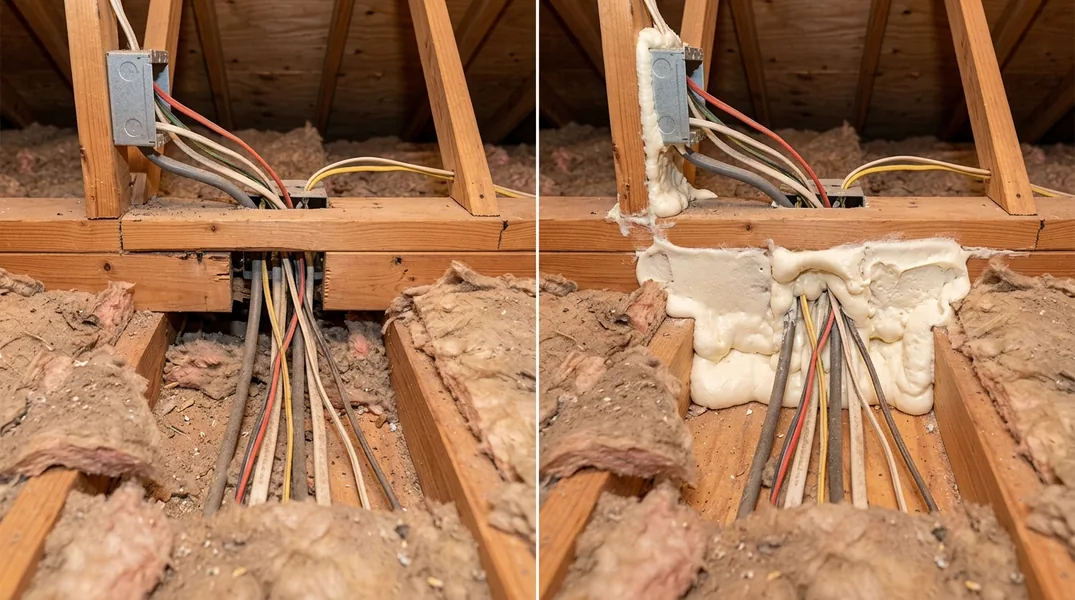
Air Sealing vs. Full Spray Foam: Understanding the Difference
When homeowners in Jacksonville begin researching attic insulation solutions, they often encounter two distinct approaches: air sealing and full spray foam installation. While these methods are sometimes presented as competing options, they actually serve different purposes and can work together to maximize your home's energy efficiency.
Air sealing focuses on identifying and closing gaps, cracks, and penetrations where conditioned air escapes from your home. This includes sealing around electrical outlets, pipe penetrations, ductwork connections, and other small openings. Full Attic Spray Foam Insulation, on the other hand, provides both an air barrier and thermal resistance in a single application. The foam expands to fill cavities and creates a continuous seal while simultaneously insulating. For most Jacksonville homeowners, the real question isn't whether to choose one or the other, but rather how much of each your home needs to achieve optimal comfort and energy savings.
Understanding Spray Foam Insulation R-Value Per Inch
The R-value is a measurement of an insulation material's thermal resistance, and it's crucial to understand how it applies to spray foam products. Closed Cell Spray Foam Insulation typically delivers an R-value of 6 to 7 per inch, making it one of the most efficient insulation materials available. Open Cell Spray Foam Insulation, by contrast, provides approximately 3.5 to 3.6 R-value per inch but costs less and offers better sound dampening properties.
For homeowners deciding between these options, the choice often comes down to budget and specific needs. Closed cell foam is denser and provides superior moisture resistance, making it ideal for Jacksonville's humid climate where moisture control is essential. Open cell foam is more affordable and works well in interior applications where moisture isn't a primary concern. Both types significantly outperform traditional fiberglass batts, which typically offer only 3.2 to 3.8 R-value per inch. When you apply spray foam to your attic, you're investing in a material that delivers genuine thermal performance while simultaneously sealing air leaks that traditional insulation cannot address.
R-Value Requirements by State and Jacksonville's Specific Needs
Florida's climate presents unique insulation challenges that differ from colder northern states. The Florida Building Code requires a minimum of R-30 insulation in attics for most residential applications, though many energy-conscious homeowners and builders are now installing R-38 or even R-49 for enhanced efficiency. Jacksonville's subtropical climate means your attic faces intense summer heat gain, making adequate insulation critical for keeping cooling costs manageable during the hottest months.
Because spray foam provides superior R-value per inch compared to traditional insulation, you can achieve Florida's R-30 requirement with just 4 to 5 inches of closed cell foam versus 8 to 10 inches of fiberglass. This efficiency matters in Jacksonville homes where attic space may be limited or where moisture control is paramount. The state's humidity levels mean that any insulation solution should include proper air sealing and vapor management, both of which spray foam naturally provides. If you're unsure whether your current attic insulation meets current codes or if you want to exceed minimum requirements for better comfort and savings, contact Jacksonville Spray Foam Insulation at (904) 816-3633 for a professional assessment.
How Thick Should Spray Foam Be in Your Jacksonville Attic
The ideal thickness of spray foam depends on your target R-value, the type of foam selected, and your home's specific conditions. If you're aiming for Florida's minimum R-30 requirement using closed cell spray foam, you'll need approximately 4.5 to 5 inches. For superior energy performance and greater comfort, many Jacksonville homeowners opt for R-38 to R-49, which translates to 6 to 8 inches of closed cell foam. Open cell foam would require roughly 9 to 14 inches to achieve the same R-values, which is one reason closed cell is often preferred for attic applications where space is limited.
The thickness decision should also account for your attic's ventilation needs and structural limitations. Spray foam can be applied directly to roof decking to create a conditioned attic space, which eliminates the need for soffit and ridge vents and allows you to insulate attic-mounted HVAC ducts and equipment. Alternatively, if you're maintaining a vented attic, foam should be applied to the attic floor between joists. A qualified contractor will evaluate your specific situation and recommend the optimal thickness. The cost difference between 5 inches and 8 inches is modest compared to the long-term energy savings, and thicker applications provide better noise reduction and moisture control for Jacksonville's climate.
Insulation Tax Credits and Rebates for Jacksonville Homeowners
One of the most attractive aspects of upgrading your home's insulation is the potential for financial incentives. The federal government has offered insulation tax credit programs that allow homeowners to deduct a portion of qualifying energy efficiency improvements from their federal income taxes. These incentives have been expanded in recent years, making now an excellent time to invest in spray foam insulation. Homeowners who install qualifying insulation may be able to claim up to 30 percent of the cost, up to certain annual limits, directly on their federal tax return.
Beyond federal incentives, Florida and local utility companies in Jacksonville often offer insulation rebates for energy efficiency upgrades. Jacksonville Electric Authority (JEA) and other regional providers frequently run rebate programs that reward homeowners for improving their home's thermal envelope. These rebates can significantly reduce your out-of-pocket expenses and improve the return on investment for spray foam installation. When you contact Jacksonville Spray Foam Insulation for your free estimate, our team can discuss available incentives and help you understand how to maximize these opportunities. Don't overlook these financial benefits, as they can offset a substantial portion of your insulation project cost.
Spray Foam Insulation Cost in Jacksonville: What to Budget
Understanding the investment required for spray foam insulation is essential for homeowners planning their energy efficiency upgrades. The pricing for spray foam varies based on the type of foam (closed cell versus open cell), the thickness applied, your attic's square footage, and the complexity of the installation. Closed cell spray foam typically ranges from $1.50 to $2.50 per board foot, while open cell foam costs $0.60 to $1.00 per board foot. For a typical Jacksonville home with a 1,500 square foot attic receiving 6 inches of closed cell foam, you might expect an investment between $4,500 and $7,500 before accounting for available tax credits and rebates.
While spray foam costs more upfront than traditional fiberglass insulation, the superior performance, durability, and energy savings justify the expense for most homeowners. A properly installed spray foam system can reduce heating and cooling costs by 15 to 30 percent, depending on your home's current condition and how much air sealing is performed. When you factor in federal tax credits, utility rebates, and the long-term energy savings, the actual net cost becomes much more reasonable. Additionally, spray foam typically lasts the lifetime of your home without settling or degrading, whereas fiberglass batts may need replacement after 15 to 20 years. For a detailed quote tailored to your home's specific needs, call Jacksonville Spray Foam Insulation at (904) 816-3633 or request your free estimate online.
When to Call a Professional Spray Foam Contractor Near Me
Installing spray foam insulation is not a DIY project for most homeowners. The equipment required is specialized and expensive, the application demands proper training to avoid overspray and ensure even coverage, and improper installation can compromise your home's performance and create liability issues. Professional contractors have invested in commercial-grade spray foam rigs, safety equipment, and training to deliver results that meet building codes and manufacturer specifications. When you hire Jacksonville Spray Foam Insulation, you're working with technicians who understand Jacksonville's climate, local building codes, and the specific challenges of attic insulation in Florida homes.
A professional contractor will also ensure your spray foam installation complies with all safety and building code requirements. They'll properly ventilate the attic if needed, protect electrical wiring and fixtures, and apply the foam at the correct thickness and density. They can also identify additional air sealing opportunities that will maximize your energy savings. Whether you're interested in Wall & Injection Foam Insulation for older homes or comprehensive attic spray foam, professional installation guarantees quality results and protects your investment. Contact Jacksonville Spray Foam Insulation today at (904) 816-3633 to schedule a consultation and learn how spray foam can transform your home's comfort and efficiency.
Looking for a professional spray foam insulation contractor in Jacksonville? Jacksonville Spray Foam Insulation responds fast for all your spray foam insulation needs.
Get a Free Quote